From Judit Polgár to Hou Yifan
Two roads are not freedom when on keeps dragging you back
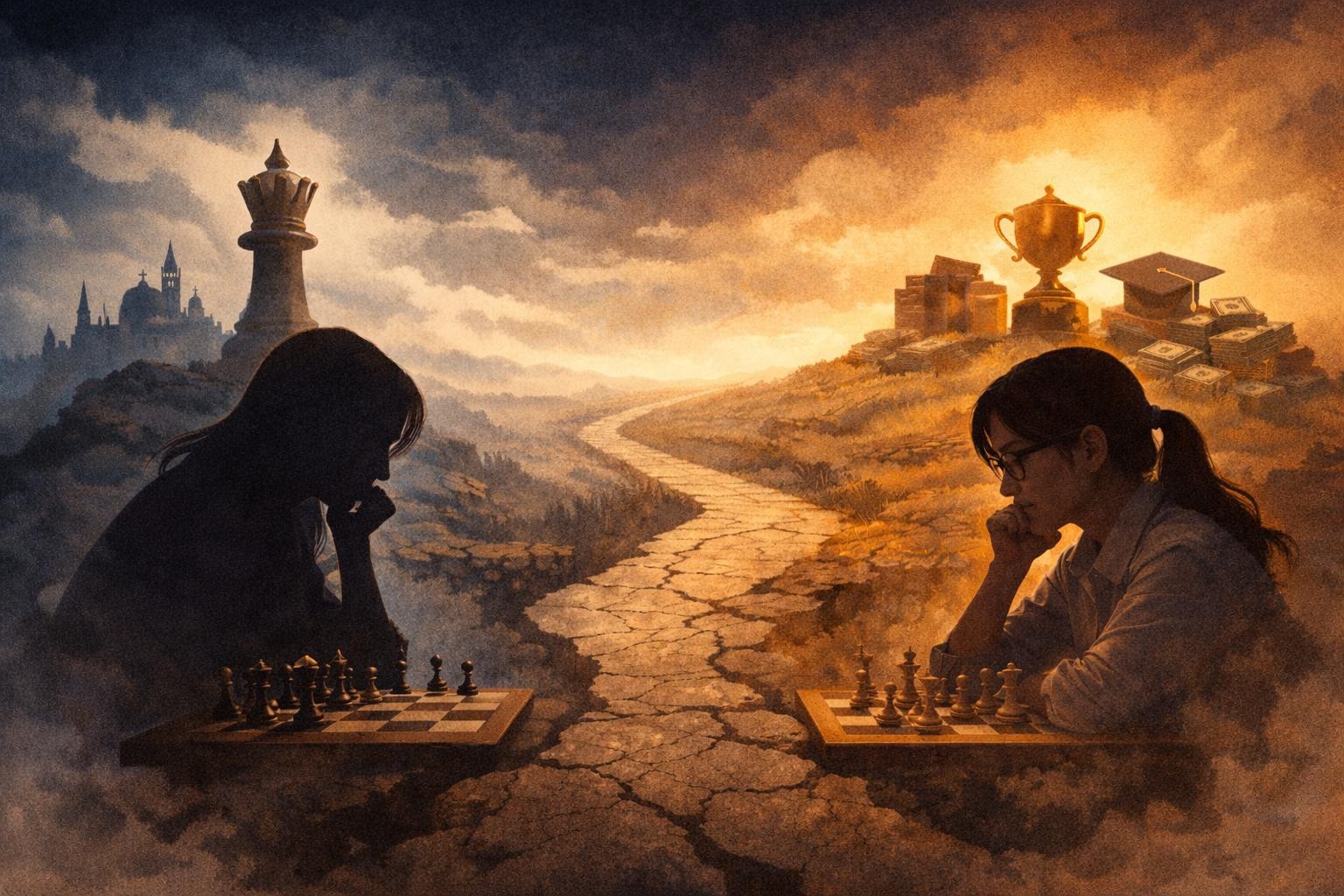
I was looking up chess history on Wikipedia, from Karpov to World Chess Championship… To my surprise, there is a separate category for Women’s Chess.
For physical sports like tennis, it makes sense to have men’s and women’s tournaments given the gender difference in physical ability. But Chess? It is a cognitive activity and there is no cognitive difference that would warrant one gender needing a separate tournament, or so one would think.
This is not an outrage on my part, just confusion. I started looking up the history:
Women’s chess as a category was created with good intentions. For most of chess history, women were actively discouraged from competitive play; Chess clubs, tournaments, and informal training spaces were male-dominated and often hostile; Girls were far less likely to be introduced to chess early or trained seriously; As a result, participation rates were extremely skewed. The women’s titles and championships were introduced to increase participation, provide visible role models, create financial and institutional incentives to keep women in the game. In other words, it’s a policy intervention, not a statement about capability.
That all make sense. But did the policy intervention achieve what it intended?
Judit Polgár
Judit Polgár is a Hungarian Chess Grandmaster and ranked 8th in the world. Competed at the highest level, her highest Elo was 2735. She had defeated eleven current or former world champions in either rapid or classical chess: Magnus Carlsen, Anatoly Karpov, Garry Kasparov, Vladimir Kramnik, Boris Spassky, Vasily Smyslov, Veselin Topalov, Viswanathan Anand, Ruslan Ponomariov, Alexander Khalifman, and Rustam Kasimdzhanov.
I am intentionally sparing you the “first woman”, “only woman”, “strongest female” phrasing used on her wikipedia page. Judit Polgár never actually competed in any Women’s Chess tournaments. Her father is the famous László Polgár, who devoted himself to his three daughters’ education, to prove that children could make exceptional achievements if trained in a specialist subject from a very early age. “Nurture over nature”. Two of his daughters went on to become chess grandmasters, and one international master.
She is not the beneficiary of Women’s Chess as a Category. She didn’t need it and it left no trace on her. And thanks to her father who trained her from a young age as a human rather than a woman in chess… it taught her to reject setting a limit on herself, regardless of the intention of the limit.
Rejecting the limit doesn’t mean gender is not limiting from the outside. I am stunned to read that Garry Kasparov, in particular, made a number of dismissive remarks about women’s chess over the years, some of which can be found with references on Judit Polgár’s wikipedia page.
Hou Yifan
Hou Yifan is a Chinese Chess Grandmaster. Winning many Women’s World Chess Champion, after Polgár’s retirement, she was widely regarded as the strongest active female player, her highest ranking was top 100 in the world. She has been the No. 1 ranked woman in the world since September 2015.
Vladimir Kramnik once said this about Hou: “If she wants to stay the best female player, she can probably do nothing. If she wants to achieve her potential, she must concentrate fully on chess.”
But Hou had different ideas, she would rather treat Chess as a hobby and pursue her academic interests and career. She said in 2018: “I want to be the best, but you also have to have a life.”
Her choices reflect her personal priorities, but even as a hobby, chess is more stimulating when you are getting strong cognitive challenges. In chess, playing the strongest opponents accelerates growth: Karpov once said that if he had had the opportunity to play Fischer for the 1975 championship in his twenties, he could have been a much better player as a result.
This unfortunately is not the case for Hou with regard to the competitiveness in Woman’s Chess. It created a ceiling that once reached - fame, sponsorship expectations and prize money all follow, it even opened doors for her career in academia. As a result, the comfort that came with Women’s Chess is safer for Hou, but it also alters the incentive landscape in which her ambition is exercised. Even though Hou did also participate in open Chess Tournaments, having set the ceiling early contributed to her mentally deprioritizing Chess into a hobby.
The Comfortable Road
This is not a criticism against Hou, by any means she has achieved in Chess what vast majority of even smart people can’t, regardless of gender. But it did prompt me to self-reflect because this goes beyond chess. When the system offers you a ceiling with rewards attached, when it rewards adequacy and punishes excess striving; it slowly teaches people to confuse survival with direction, and stop wanting.
In my high school, students are ranked among the whole school in exams. I underperformed at one of the first exams: “damn it, I messed up”. But when the teacher was summarizing the results, he said “xx got the highest grade in our class and yy (me) got the highest grade among girls”… I was surprised, what does that even mean? Not insulted, I was in high school after all. It is not unlike my reaction when I discovered that there a separate woman’s category for Chess. Academic performance is also a cognitive exercise blended with hard work, just like Chess. Luckily, that was an exception rather than the rule, the school does not actually rank girls separately, and I didn’t box myself in. I went on to be No. 1 ranked student in my school till the end of high school.
But this trap is all too common in our lives: A “safe road” keeps reasserting itself, it tempts you to choose it over other paths where you are more likely to live a fuller life. It creates opportunity cost, not unlike missing one’s potential in Chess.
When a safer road repeatedly presents itself as reasonable, responsible, even benevolent, it does not feel like a choice at all. It feels like gravity. And over time, that gravity tragically destroys ambition, by making it perpetually deferrable. Excellence never grows under deferral. It requires a horizon that recedes only by being pursued, it needs opponents that force continual reorganization rather than maintenance.
Where parallel roads exist, the danger is not being boxed in from the outside, but being pulled back from the inside, until survival is mistaken for direction, and coherence gives way to comfort. The cost is not visible in failure, but in the slow erosion of what one was aiming at in the first place.
The issue is not which road is taken, but how easily one forgets that a road is being taken at all.